



The Importance of Hotel Locations in Coastal Environments
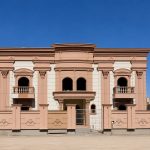
Hotels in Coastal Environments require facade designs that do more than attract guests; they must also take into account the nature of the location and the conditions associated with it, including high humidity, sea salts, strong sunlight, and winds carrying spray and dust. The facade is the first thing visitors see, while at the same time serving as the building’s first line of defense against external conditions. Therefore, it should be treated as an essential part of the project’s quality rather than merely a decorative element.
In hospitality projects, a well-designed facade contributes to creating an immediate impression of the hotel. Architectural details, color harmony, shadow distribution, and material selection all influence the image of the property and the guest experience from the moment of arrival.
This becomes even more important for Hotels in Coastal Environments, as selecting an unsuitable material or improperly executing fixing points may, over time, lead to deterioration of the exterior appearance, increased maintenance requirements, and higher operating costs.

To learn more, explore our services and discover how we meet your project requirements with efficiency and high quality.
Choosing the Right Materials for Coastal Facades
The success of facades for Hotels in Coastal Environments depends on studying the site before finalizing the design. It is important to understand wind directions, the building’s proximity to the sea, its exposure to direct sunlight and humidity, as well as the hotel’s daily usage patterns. This information helps determine the appropriate cladding, finishes, fixing systems, and insulation solutions.
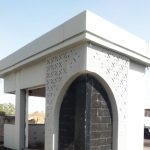
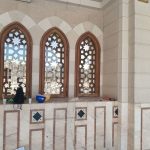
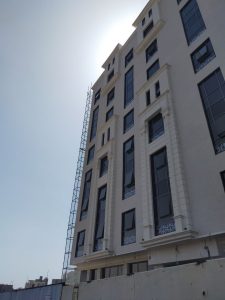
Materials such as GRC, GRP, and UHPC are among the options used for exterior architectural elements because they provide significant design flexibility. They can be used to create cornices, arches, columns, window frames, canopies, and decorative fins, with the ability to develop custom molds that suit the identity of each project.
GRC (Glass Fiber Reinforced Concrete) is a cement-based material reinforced with alkali-resistant glass fibers and is used to manufacture precast facade panels and architectural elements. Its fibers also help improve resistance to cracking and impact compared with traditional cement mortar, provided that the appropriate mix, proper curing, and execution in accordance with the project’s technical specifications are maintained.
However, material quality alone is not sufficient. Attention must also be given to details such as joint treatment, water drainage, protection of fixing points, and selecting accessories suitable for coastal environments. These details help maintain the facade’s performance and preserve its appearance for a longer period.
From Design to Precise Execution
A successful facade begins with a clear architectural concept and is then transformed into precise drawings that define the dimensions, materials, and installation method for each component. For Hotels in Coastal Environments, it is preferable for the architect, engineer, and manufacturer to collaborate from the early stages, as early coordination reduces unexpected modifications and prevents conflicts between facade elements, openings, and service installations.
Takween Industrial provides integrated solutions for designing, manufacturing, and executing exterior facade elements. The process begins with understanding the nature of the project and the desired outcome, followed by developing the elements, molds, and finishes in line with the building’s architectural identity. Whether the hotel has a simple contemporary style or a classical design rich in detail, the concept can be transformed into practical elements suitable for manufacturing and installation.
Using modeling and verification before production also helps ensure that the components correspond to the building’s dimensions and facilitates the planning of installation stages on site. These steps are particularly important for Hotels in Coastal Environments, where the facade must be executed efficiently to minimize work periods that could affect project operations or guest movement.
Sustainability does not always mean selecting a single material; rather, it means choosing an integrated system that serves the building for years: suitable materials, a design that facilitates maintenance, precise manufacturing, and proper installation. A well-executed facade reduces waste, preserves the hotel’s visual value, and supports a better hospitality experience.
Therefore, when planning any of the Hotels in Coastal Environments, the facade should be viewed as a long-term investment. With Takween Industrial’s experience in GRC, GRP, and UHPC solutions, it becomes possible to combine architectural luxury, executional precision, and the practical requirements of coastal locations.
Access Takween’s solutions with ease and contact us now to help bring your project to life with high efficiency.
لا تعليق