







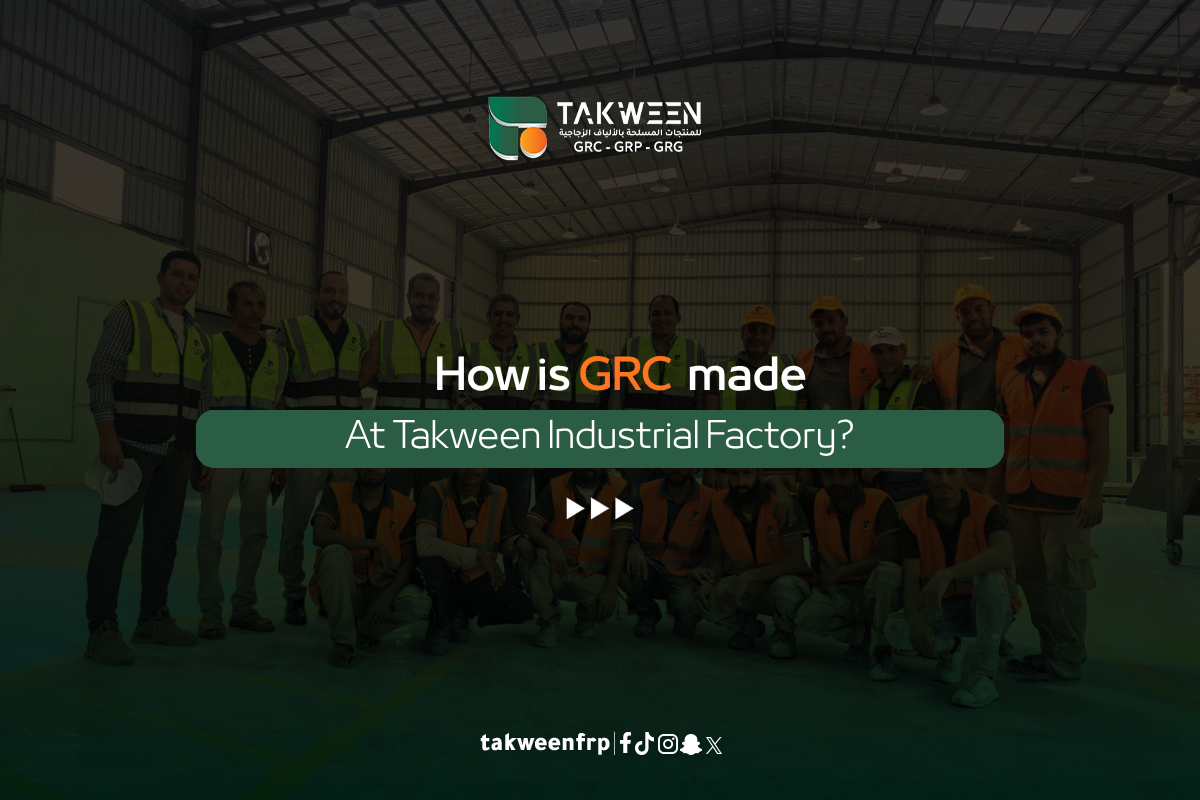
Many engineers and developers choose Glass Reinforced Concrete (GRC) for their facades without fully understanding what happens inside the factory before each piece reaches the project site. This knowledge is not just technical curiosity — it is what separates a client who understands the value of what they are purchasing from one who compares based on price alone.
At Takween Industrial, Glass Reinforced Concrete (GRC) Manufactured is not just a production process — it is a fully integrated system that starts with raw material selection and ends with delivering a ready-to-install product with precise specifications. This article takes you inside the المصنع خطوة بخطوة.
First: Raw Material Selection — The Foundation You Don’t See
The production of Glass Reinforced Concrete (GRC) Manufactured begins before any mold is touched. The cement used must be alkali-resistant, and the glass fibers must be classified as AR (Alkali Resistant), as standard fibers deteriorate داخل الخلطة الأسمنتية over time.
At Takween Industrial, raw material selection follows strict standards because the final quality of Glass Reinforced Concrete (GRC) Manufactured is determined at this stage before any other.
Second: Mix Preparation — Precision in Ratios
The mix in Glass Reinforced Concrete (GRC) Manufactured is not just cement, water, and fibers — it is a precise formula that includes defined ratios of Portland cement, fine sand, performance additives, and alkali-resistant glass fibers.
Any imbalance in these ratios directly affects the mechanical properties of the final product — flexural strength, rigidity, and impact resistance. That is why a professional GRC factory in Saudi Arabia relies on lab-tested formulations rather than manual estimation.
Third: Mold Fabrication — Where Design Takes Shape
Before casting, molds must be produced to define the final geometry of each element. At Takween, molds are created from various materials depending on the design — polymer molds for complex curved forms, and wooden or steel molds for linear and repetitive elements.
Mold accuracy equals product accuracy — ensuring full visual consistency across large-scale Glass Reinforced Concrete (GRC) Manufactured projects that require thousands of identical pieces.
Fourth: Spraying or Casting — Two Methods, One Standard
In Glass Reinforced Concrete (GRC) Manufactured, there are two main forming methods:
Direct Spray Process: The mix and fibers are sprayed simultaneously onto the mold in successive layers using specialized equipment. This method is ideal for curved surfaces and complex geometries.
Premix Process: Fibers are pre-mixed with the cementitious mix and then poured into the mold. This method suits thicker sections with fine detailing.
The choice of method depends on design complexity and project requirements — a decision made by Takween’s engineering team based on detailed project analysis.
Fifth: Curing — Strength Through Controlled Conditions
After forming, elements enter the curing stage, which is one of the most critical phases in Glass Reinforced Concrete (GRC) Manufactured. Improper curing significantly weakens mechanical performance.
At Takween Industrial, elements are cured under controlled temperature, humidity, and timing conditions to ensure the cement matrix reaches maximum strength before any surface finishing.
Sixth: Surface Finishing — A Balance of Aesthetics and Protection
Once curing is complete, finishing defines the final appearance. In Glass Reinforced Concrete (GRC) Manufactured, multiple finishes can be applied based on design intent:
Smooth finishes for modern, clean facades.
Stone-like textures to replicate natural materials.
Polished finishes for detailed decorative elements.
Protective coatings to enhance environmental resistance and extend lifespan.
Seventh: Quality Testing — No Product Leaves Unchecked
A professional GRC factory does not just produce — it verifies. At Takween Industrial, all Glass Reinforced Concrete (GRC) Manufactured elements undergo mechanical testing, including flexural strength, impact resistance, and compressive performance, along with detailed visual inspections.
This stage defines the difference between controlled manufacturing and random production.
Eighth: Packaging and Delivery — Precision Until the End
A precisely manufactured element must arrive in perfect condition. At Takween Industrial, Glass Reinforced Concrete (GRC) Manufactured products are carefully packaged to prevent cracks or damage during transport, with full shipment documentation including specifications and installation guidelines.


Takween Industrial: Where Glass Reinforced Concrete (GRC) Manufactured Meets Your Ambitions
At Takween Industrial, every stage of Glass Reinforced Concrete (GRC) Manufactured is supervised by engineers with over 25 years of experience in the Saudi market. Because we believe a GRC factory is defined not by its size, but by the quality standards it maintains in every piece it produces.
Conclusion
Glass Reinforced Concrete (GRC) Manufactured is not a simple production line — it is a complete system that includes raw material selection, precise mold fabrication, controlled mix design, proper curing, and strict quality testing before delivery. The production process at Takween Industrial ensures that every piece delivered carries decades of expertise and commitment.
Does your project require high-standard facade solutions?
The Takween team provides the expertise needed to deliver facade systems based on well-studied engineering standards that ensure performance and long-term stability.
Get Takween solutions بسهولة، وcontact us today to support your project with efficiency and precision.
لا تعليق